


You will not be allowed to compare more than 4 products at a time
View compareLewanSoul RC Digital Servo Tester - 6 Channel Motor Controller with Over-Current Protection, PVC, 2 Control Modes, SG_B073XZH264_US
LewanSoul RC Digital Servo Tester - 6 Channel Motor Controller with Over-Current Protection, PVC, 2 Control Modes, SG_B073XZH264_US
Regular price
$24.05 USD
Sale price
$24.05 USD
Regular price
$24.05 USD
Unit price
per
Shipping calculated at checkout.
Out of stock
Sold by ToyTooth — Your trusted kids' toy store.
Returns accepted within 30 days | support@toytooth.com
Shipping Information
- Free Shipping Across the USA
- Processing Time: 3–5 business days
- Estimated Delivery: 6–10 business days after dispatch
- Securely packed to ensure your purchase arrives in perfect condition
- Tracking number sent via email once dispatched
Returns & Refund
Returns accepted within 30 days of delivery.
Damaged or Defective Item
Free return shipping + replacement or full refund
Wrong Item Received
Free return shipping + replacement or full refund
Change of Mind
Return shipping at customer's expense · Item must be unused & in original packaging
All returns require a Return Authorization (RA) number before sending.
View Full Return & Refund Policy
Safety & Compliance
⚠️
California Proposition 65 Warning
Some products sold on this website may expose you to chemicals known to the State of California to cause cancer, birth defects, or other reproductive harm.
www.P65Warnings.ca.gov
🛒
General Product Safety Advisory
Always read the product label, instructions, and safety warnings before use. Do not use damaged or modified products. Store products in appropriate conditions as specified by the manufacturer.
Keep all products out of reach of children unless specifically designed for their use.
ℹ️
Product Authenticity & Notice
All products sold by ToyTooth are 100% authentic, sourced directly from trusted toy suppliers and brands. Product colors and dimensions may vary slightly from images due to screen calibration and manufacturing tolerances.
ToyTooth — Fun Toys for Every Kid, Delivered to Your Door.
Share
Couldn't load pickup availability
Guarantee safe and secure checkout
Description
Description
The LewanSoul Servo Tester 6ch is a high-precision digital servo controller designed for robotics enthusiasts and professionals. This versatile device allows for precise control of multiple PWM servos, making it ideal for applications in robotics, including robotic arms and AI-driven projects.
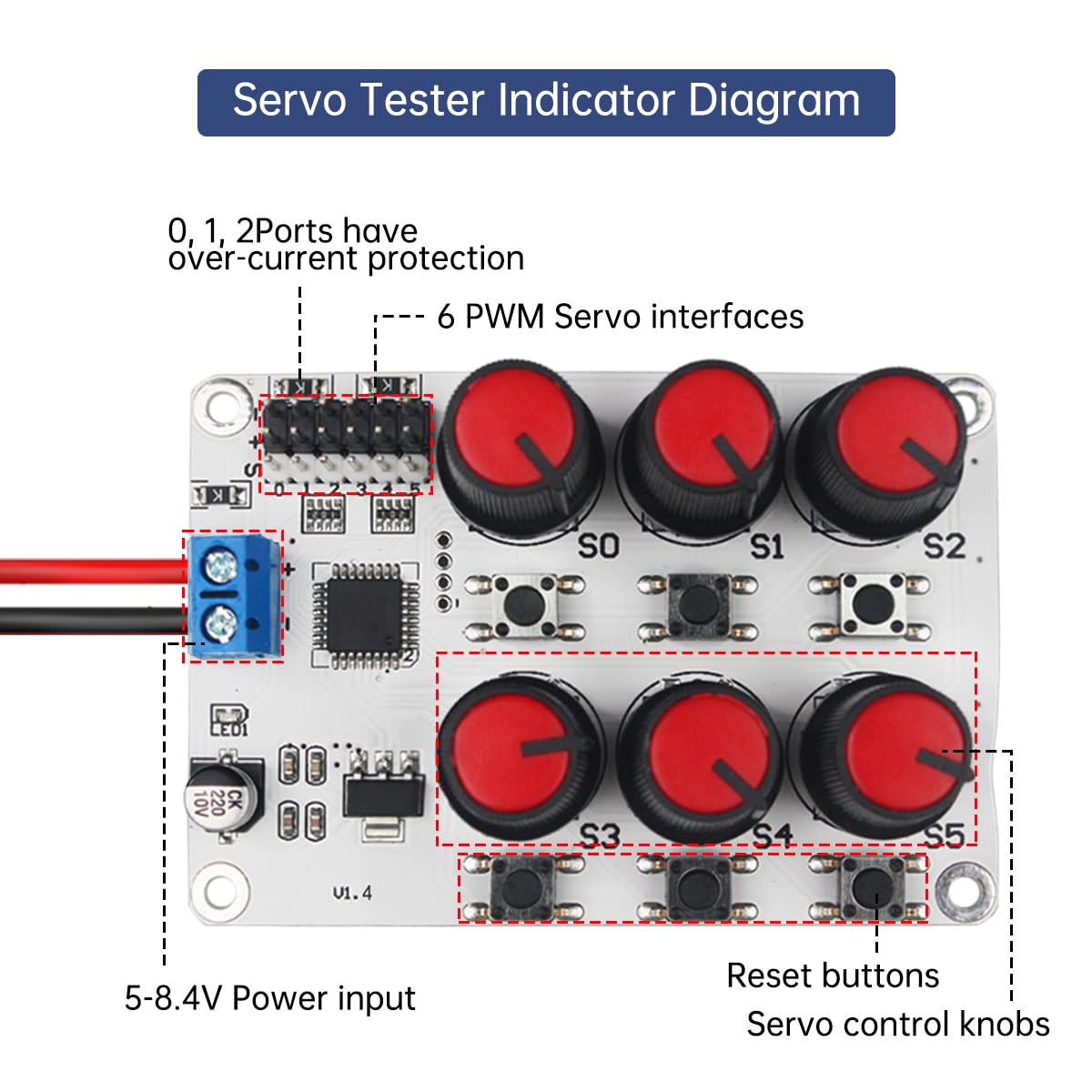
Constructed from durable PVC material, the Servo Tester 6ch boasts a compact design with dimensions of 76mm x 53mm (2.99in x 2.09in) and a lightweight profile of just 37g (1.31oz). It is powered by either a Lipo battery or a power adapter, accommodating a voltage range of 5-8.4V. The controller features a 6-channel PWM digital servo port, enabling manual angle adjustments without the need for coding. Its high-accuracy potentiometer ensures exceptional precision in servo control, with a control accuracy of up to 0.09°, allowing for minimal changes with a 1µs PWM limit. The integrated overcurrent protection safeguards your servos with 3-channel protection, preventing potential damage during operation.
Key Features:- Specifications: 76mm x 53mm (2.99in x 2.09in), Weight: 37g (1.31oz).
- Power Supply: Compatible with Lipo batteries or power adapters, operating within a voltage range of 5-8.4V.
- Manual Adjustment: Equipped with a 6-channel PWM digital servo port for easy manual angle adjustments.
- Controller Accuracy: Achieves control accuracy of 0.09° for precise servo control.
- Overcurrent Protection: Features 3-channel overcurrent protection to prevent servo damage.
- Versatile Applications: Suitable for use in grippers, AI robots, robot arms, and more.
- Material: Constructed from durable PVC for long-lasting performance.
The LewanSoul Servo Tester 6ch is an excellent choice for hobbyists, educators, and professionals engaged in robotics and automation. Its ease of use, coupled with robust performance features, makes it a valuable tool for anyone looking to enhance their projects with precise servo control. This product is perfect for those who demand accuracy and reliability in their robotics applications.


Frequently Asked Questions
- Q: What are the dimensions of the RC Digital Servo Tester? A: The dimensions are seventy-six millimeters by fifty-three millimeters.
- Q: What is the weight of the servo tester? A: The weight is thirty-seven grams.
- Q: What is the power supply voltage range for this device? A: The power supply operates within a voltage range of five to eight point four volts.
- Q: What materials are used in the construction of the servo tester? A: The main material used is PVC.
- Q: How many channels does the servo tester support? A: It supports six channels.
- Q: What control modes does the servo tester have? A: It features two control modes for flexibility in operation.
- Q: How do I use the RC Digital Servo Tester? A: To use it, connect your PWM servos and adjust the potentiometer for precise control.
- Q: Is the servo tester suitable for beginners? A: Yes, it is user-friendly and suitable for both beginners and experienced users.
- Q: Can I use this tester for robotics applications? A: Yes, it is ideal for applications like grippers, AI robots, and robot arms.
- Q: How do I ensure the servo tester lasts long? A: Avoid overloading the channels and make sure to utilize the overcurrent protection features.
- Q: How should I store the servo tester? A: Store it in a dry place, away from extreme temperatures and moisture.
- Q: What safety features does the RC Digital Servo Tester have? A: It includes overcurrent protection on three channels to prevent servo damage.
- Q: What if the servo tester does not power on? A: Ensure it is connected to a compatible power source within the specified voltage range.
- Q: Can I connect multiple servos at once? A: Yes, you can connect multiple PWM servos to the six-channel ports.
- Q: What should I do if my servo tester is damaged during shipping? A: Contact customer support for assistance with returns or exchanges.