

Every toy store aisle has a section labeled 'educational.' Half of what's in it is aimed at two-year-olds. And yet, if you ask most parents what skills a two-year-old is actually developing right now — like, the cognitive and motor stuff that's genuinely active this month — most would pause. You buy the toy with the bright colors and the promising box copy, and hope for the best.
That's not a criticism. It's just that nobody hands you a development roadmap when your kid turns two. So here's a practical one — and a way to match what you buy to what your child's brain and body are actually doing.
What's Actually Happening at Age Two
Two is a genuinely busy developmental window. A few things are happening at once, and they're worth knowing because they tell you exactly what kind of play will feel satisfying and productive for your child — versus what will just frustrate them.
1. Language Is Exploding
Around age two, most children go from single words to short phrases and sentences. Vocabulary grows fast during this period, and kids are making connections between words, objects, and actions constantly. They're not just learning what things are called — they're learning what things do and how to ask for them.
Toys that name things, repeat sounds, or prompt back-and-forth interaction feed this directly. Anything that rewards a child for identifying an object, an animal, or a color is working with this window, not against it.
2. Fine Motor Control Is Coming Online
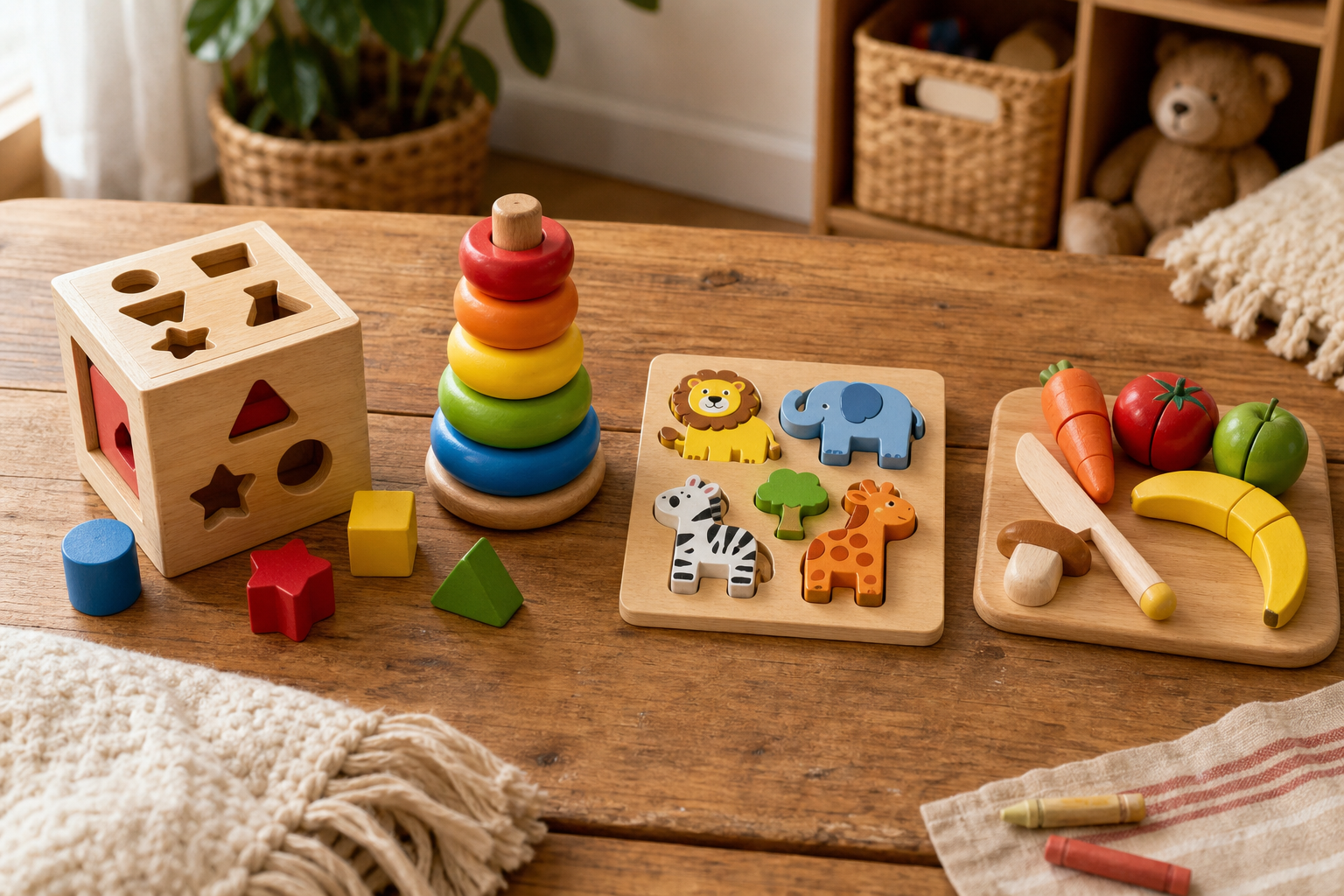
At two, kids are figuring out how to control their hands with more precision. Stacking, sorting, fitting shapes into slots, turning pages, scribbling with purpose — these aren't just cute activities. They're the early groundwork for writing, drawing, and self-care tasks like buttoning and using utensils.
This is why simple puzzles, stacking toys, and shape sorters aren't 'baby toys' at two — they're exactly right. The challenge level matters: too easy and there's no engagement, too complex and it becomes a meltdown. Pieces that fit together with some effort but not too much are the sweet spot.
3. Symbolic and Pretend Play Is Starting
Around 18 to 24 months, children start using objects to represent other things. A block becomes a phone. A spoon becomes a wand. This is symbolic thinking — one of the earliest forms of abstract reasoning — and it shows up as pretend play. Feeding a stuffed animal, 'cooking' in a play kitchen, or driving a toy car through an imaginary town are all signs this skill is active.
Toys that invite this kind of open-ended pretending — rather than scripting exactly one outcome — are genuinely valuable here. The toy doesn't need to do the imagining for the child.
4. Cause and Effect Is Being Tested Constantly
Two-year-olds are scientists in the most literal sense: they push things to see what falls, drop food to see if the dog comes, press every button on every toy to see what happens. They're building a mental model of how the world works, and they do it through repetition. This is why your child will drop the same spoon seventeen times and find it funny every time — they're confirming a hypothesis.
Toys that respond clearly and predictably to the child's action — a button that makes a sound, a lever that pops something up, a ball that rolls when pushed — satisfy this drive without overstimulating it.
How to Match a Toy to the Skill
Now that you know what's active, here's how to think about what to buy — mapped to each developmental area.
For language development: Look for educational toys that name objects, animals, letters, or colors out loud — interactive learning tablets, talking books, or simple matching games where a child identifies pictures. The key is that the toy responds to the child's choice, not just plays a loop of sounds regardless of what they do.
For fine motor control: Simple wooden puzzles, stacking rings, shape sorters, and basic building sets are ideal. Wooden toys in particular tend to have a satisfying weight and fit that plastic versions often don't — which makes the physical feedback more meaningful for small hands learning to control their grip.
For pretend play: Open-ended sets work better than single-purpose toys here. A set of wooden food pieces, a small play kitchen, or a simple dollhouse invites the child to direct the story. The toy is a prop, not the main character.
For cause and effect: Look for toys with clear, immediate responses — a button that triggers a sound or light, a simple musical instrument, or a ball drop tower. The response needs to be fast and obvious. Two-year-olds don't have the patience for delayed feedback, and they shouldn't have to.
One Thing Worth Avoiding
The toys that do the most — lights, sounds, songs, animations, all at once — are often the least developmental at this age. When a toy provides all the stimulation itself, the child becomes an audience rather than a participant. The best toys for a two-year-old require something from the child: a choice, a physical action, a decision. That's where the learning actually happens.
This doesn't mean screens or electronic toys are off the table entirely. But if a toy works the same way whether the child is paying attention or not, it's probably not doing much for development.
Age-Appropriate Doesn't Mean Boring
There's a version of 'developmental toy' that sounds like medicine — worthy but dull. It doesn't have to be. A well-designed wooden stacker is beautiful. A good shape sorter is genuinely satisfying to complete. A pretend play set can hold a two-year-old's attention for longer than most electronic toys because the child is the one generating the story.
The sweet spot is a toy that matches where your child actually is right now — not where they'll be in a year, and not where they were six months ago. That's the version of 'educational' that actually means something.
Browse Toytooth's Baby & Toddler toys and Educational Toys sections to find options sorted by age and developmental focus — it's a faster way to find the right fit than reading every box in a store aisle.
Frequently Asked Questions
How do I know if a toy is actually age-appropriate for a 2-year-old?
Check the manufacturer's age recommendation first — it's usually based on safety (small parts, choking hazards) as much as developmental fit. Beyond safety, ask whether the toy requires something from your child: a choice, a physical action, or a decision. If it does, it's probably working with where a two-year-old is developmentally. If it entertains without any input from the child, it's more passive than educational.
Are wooden toys actually better than plastic for toddlers?
Not categorically, but wooden toys often have qualities that work well at this age: they tend to be simpler in design (which suits cause-and-effect and fine motor play), have a satisfying physical weight, and don't have the electronic bells and whistles that can overstimulate. For stacking, sorting, and pretend play specifically, wooden sets are often a good choice. Whether you choose wood or plastic, the design and how much it asks of the child matters more than the material.
My 2-year-old loses interest in toys quickly. What should I do?
This is common and usually not a sign that the toy is wrong — it's often a sign that the toy is too easy or too passive. Try rotating toys in and out rather than having everything available at once; novelty matters a lot at this age. Also look for toys with slightly more challenge than your child can currently master — something they almost succeed at keeps them coming back. Open-ended toys like building sets or pretend play props also tend to hold attention longer because the child is generating the play, not just watching it.
Is it okay to buy toys slightly above a 2-year-old's current ability?
A little stretch is fine and often good — a toy that's slightly ahead of where your child is right now gives them something to grow into and can hold their interest longer. The line to watch is frustration: if your child can't make any progress with a toy on their own, it'll get abandoned fast. A good rule of thumb is that the child should be able to succeed at some part of it independently, even if the full challenge takes a few more months to master.

