

Here's the thing nobody tells you when you're standing in the toy aisle squinting at packaging: "educational" is a marketing word, not a standard. Any toy can print it on the box. That doesn't mean the toy is useless — it just means the label does zero work for you as a parent trying to figure out what's actually going to help your two-year-old grow.
The good news is that two-year-olds are working on a surprisingly short list of skills at any given moment. Once you know what those are, picking the right toy gets a lot easier. So let's skip the shelf-scanning and start there.
What a Two-Year-Old Is Actually Working On
At this age, development isn't abstract. It's happening in specific, observable ways — and the toys that support it are the ones designed around these real milestones, not just bright colors and a catchy jingle.
Cause and effect. This is the big one at two. A toddler who pushes a button and sees something happen is learning that their actions change the world around them. That's not small. It's the foundation of logical thinking, problem-solving, and eventually reading comprehension. Toys that respond to what the child does — not ones that just run on their own — are the ones doing the developmental work here.
Fine motor control. Fingers are still figuring out how to pinch, stack, twist, and thread. This matters because the same grip that builds a block tower is the one that will later hold a pencil. Anything that requires deliberate hand movements — stacking rings, shape sorters, simple puzzles with chunky pieces — is genuinely building this skill.
Language and vocabulary. Two-year-olds are in a vocabulary explosion. The CDC notes that most children this age are rapidly expanding the words they understand and use. Toys that name things, prompt conversation, or involve simple storytelling feed directly into this. A toy that talks at a child is less useful than one that creates a reason for a child to talk back — or to narrate their own play.
Symbolic play. Around two, kids start to pretend. A block becomes a phone. A stuffed animal gets fed lunch. This isn't random — it's the beginning of abstract thinking, empathy, and narrative understanding. Open-ended toys that can be anything support this far better than single-purpose ones that lock the play into one script.
The Toy Types That Actually Deliver
With those skills in mind, here's what's genuinely worth your money — and why.
Shape Sorters and Simple Puzzles
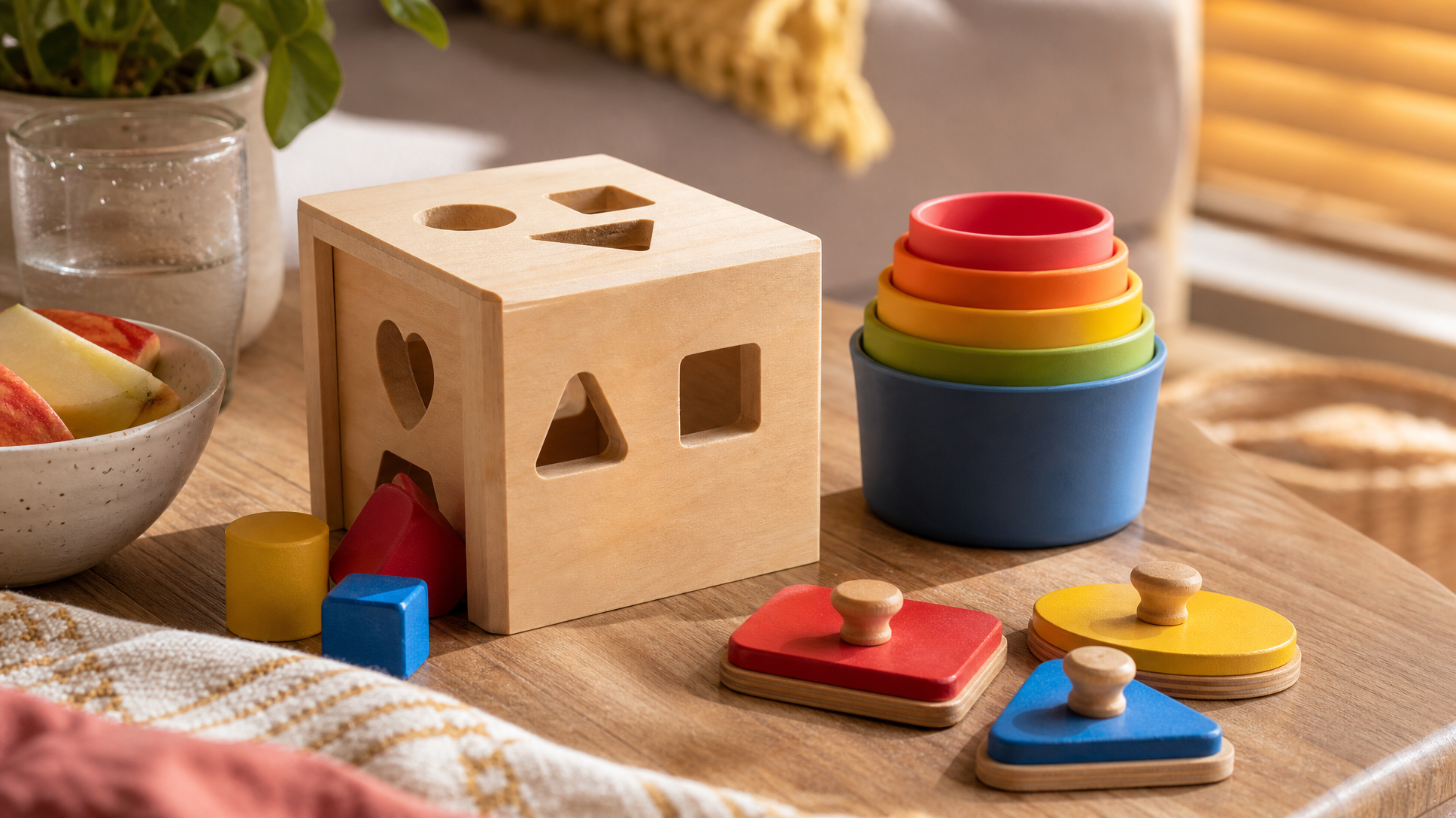
These are workhorses for a reason. A child has to rotate a shape, figure out which hole it fits, and use both hands in coordination to make it work. That's cause-and-effect thinking and fine motor development in one five-minute play session. Look for chunky pieces with smooth edges and a manageable number of shapes — too many options at this age is frustrating, not enriching.
Stacking and Nesting Toys
Rings, cups, blocks — anything that can be built up and knocked down. The knocking down is just as important as the building. It's a toddler running a hypothesis: if I do this, that happens. Let them repeat it thirty times. That repetition is how two-year-olds learn.
Simple Pretend Play Sets
A basic kitchen set, a doctor kit, a set of animal figures. The toy doesn't need to do anything — the child does the work. These sets invite language ("the bear is hungry"), empathy ("the baby needs medicine"), and storytelling. They also tend to have long play lives because the child's imagination scales up as they get older.
Wooden Toys with Real Tactile Feedback
There's a reason wooden toys have stuck around. The weight, texture, and sound of wood give a toddler genuine sensory information as they play — information that plastic often flattens out. A wooden peg puzzle or set of stacking blocks also tends to be simpler in design, which means the child's brain has to supply more of the play. That's a feature, not a limitation.
Board Books and Lift-the-Flap Books
Yes, books count as educational toys at this age. A lift-the-flap book is cause and effect. Pointing to pictures and naming them is vocabulary building. Reading together is one of the highest-return activities for language development at two — and a good board book holds up to the handling a toddler will give it.
What's Usually Just Noise
This is the part that saves you money.
Toys that do too much on their own. If a toy lights up, plays a full song, dances, and tells a story without the child doing anything to make it happen, the child is the audience — not the learner. Passive entertainment has its place (every parent needs a break), but it's not doing developmental work.
"Screen-based learning" devices pitched at this age. The research on very young children and screen-based learning is mixed at best. Real back-and-forth interaction — with a toy, an object, or a person — is what builds language and cognition at two. A tablet with educational apps isn't the same as a shape sorter, even if both have the word "learning" in the description.
Toys with too many pieces or too complex a concept. A toy that's genuinely great for a four-year-old can be genuinely frustrating for a two-year-old. Frustration at this age doesn't build resilience — it ends the play session. Age ranges on packaging exist for a reason; trust them, or go slightly younger rather than older if you're unsure.
Novelty toys that only do one thing. A toy that makes one funny noise and nothing else will hold attention for about forty-eight hours. These are fine as stocking stuffers, but they're not worth treating as an educational investment.
A Practical Shortlist for Shopping
If you want a quick filter to apply at the shelf or on a product page, run any toy through these three questions:
- Does the child have to do something to make it work? If yes, it's probably building cause-and-effect thinking.
- Does it require hands? If it involves picking up, placing, stacking, or threading, it's building fine motor skills.
- Can it be played with in more than one way? If yes, it has staying power and supports creative thinking.
A toy that answers yes to all three is almost always worth buying. A toy that answers no to all three is probably just noise — no matter what the box says.
If you'd rather skip the guesswork entirely, Toytooth's Baby & Toddler Toys collection is organized by age and developmental stage, so you're not sorting through products meant for a six-year-old to find what's right for your two-year-old. It's the kind of filtering that makes a real difference when you're shopping under time pressure — which, with a toddler at home, is always.
Frequently Asked Questions
How many toys does a two-year-old actually need?
Fewer than most toy collections suggest. Toddlers tend to play more deeply with a small set of open-ended toys than they do when overwhelmed by a large pile of options. A handful of well-chosen toys that cover different skill areas — motor, language, pretend play — will serve a two-year-old better than a room full of single-purpose ones.
Are wooden toys actually better than plastic ones for toddlers?
Not categorically — but wooden toys often have design advantages at this age. They tend to be simpler, more tactilely interesting, and more durable under the kind of handling a two-year-old gives everything. The best toy is the one that matches the child's developmental stage and holds their attention; material matters less than design and age-appropriateness.
My two-year-old ignores most toys and just wants to play with household objects. Is that normal?
Completely normal — and actually a sign of healthy curiosity. Toddlers are drawn to real objects because they see adults using them. The fix isn't to buy more toys; it's to make sure the toys you do have are open-ended enough to compete with a wooden spoon and a pot. Shape sorters, stacking cups, and simple pretend play sets tend to win that competition.
What's the difference between a toy labeled "12 months+" and one labeled "2 years+"?
Usually complexity and safety. A 12-month toy is designed for a child who is still mouthing objects, so pieces are large and there are no small parts. A 2-year-old toy can introduce slightly smaller components, more steps, and more complex cause-and-effect relationships because the child has more motor control and is past the stage of putting everything in their mouth. When in doubt, follow the age range — or go slightly younger rather than older.
